Most people shopping for a travel espresso maker do the same thing: they pull up two spec sheets, find the bigger bar-pressure number, and buy that one. Eighteen beats nine. Case closed. Two weeks later they’re on a forum asking why their $130 pocket machine keeps pulling sour, thin shots no matter how fine they grind.
Espresso’s actual pressure standard was never chosen for being high. It was chosen almost by accident, by a machine that couldn’t hit eighteen bar if it tried. Put a $99 lever against a $130 hand pump and the one with the “worse” spec sheet might be the one that’s actually doing this right.
📋 Table of Contents
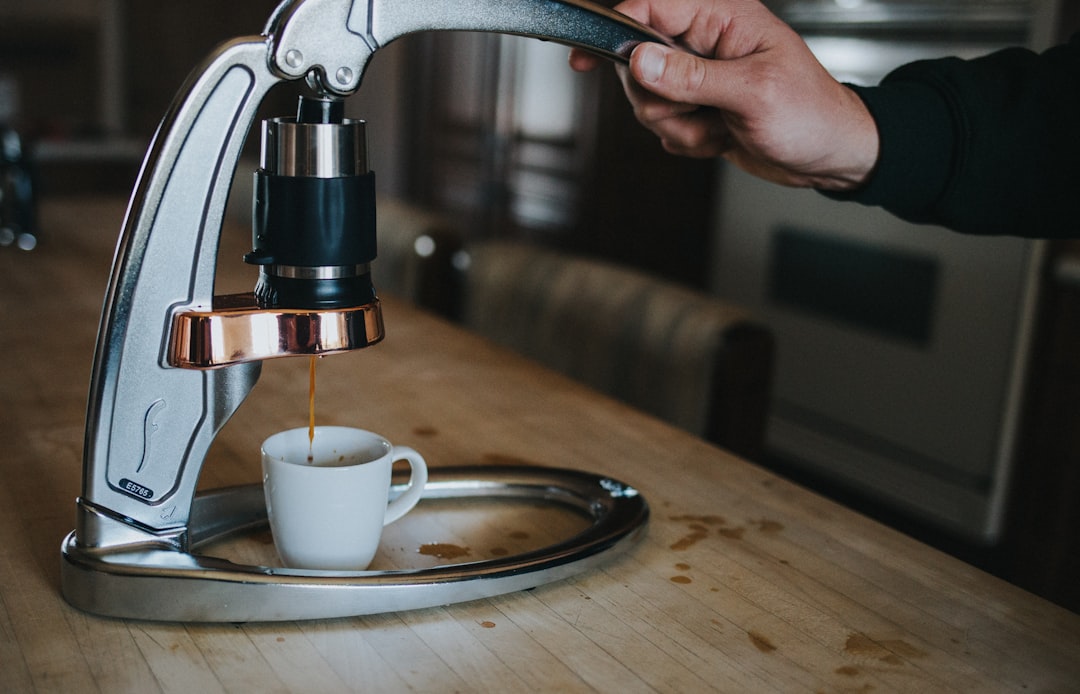
In the red corner: the Flair NEO Flex. A direct-lever espresso maker with a built-in pressure gauge, a redesigned thin-walled brew cylinder that skips preheating, and two portafilters in the box: one that forgives you, one that doesn’t. Weight with its carrying case: 3.2kg. Price direct from Flair: $99.
In the blue corner: the Wacaco Picopresso. A hand-pump piston espresso maker that fits in a jacket pocket, built around a naked portafilter so you can watch the shot pull. Weight: 350 grams. Price: $129.90.
One of these costs less and weighs ten times more.
The Contenders
Both machines do the same basic job: force hot water through compressed coffee grounds without a plug, a boiler, or a pump motor. Beyond that, they’re solving the problem in almost opposite ways.
The NEO Flex is a scaled-down version of a full lever machine, the same family as the Flair 58, just built for a backpack instead of a countertop. You supply the force with your arm through a long lever, and the built-in gauge tells you exactly how hard you’re pressing. The Picopresso is a piston pump: you load the chamber, then work a plunger with repeated hand strokes to build pressure before the shot releases through the portafilter. One is a lever. The other is a bicycle pump wearing an espresso machine’s clothes. Both, in the right hands, make a genuinely good shot — but the weight difference above is the first clue that the spec sheet isn’t going to settle this fight on its own.
Round 1: How Each One Actually Builds Pressure
This is the mechanical difference that decides almost everything else in this comparison, so it’s worth getting right before comparing a single spec.
The NEO Flex uses direct leverage. Push down on a roughly 12-inch arm and the mechanical advantage multiplies your force onto a small piston head, the same physics a full-size lever machine like a La Pavoni or a Flair 58 relies on. The pressure gauge mounted on the machine shows you, in real time, whether you’re sitting in what Flair calls the Espresso Zone. Because it’s a continuous squeeze rather than a series of strokes, you can hold steady pressure or ease into it gradually — the same idea we broke down step by step in our pressure profiling at home guide, where a shot that starts soft and builds in intensity beats a flat line held for thirty seconds straight.
The Picopresso works differently. You pump a plunger by hand, in short bursts, to charge the chamber before water is pushed through the puck. Wacaco’s own product spec sheet lists a maximum pumping force of roughly 13kg, or about 28 pounds of hand effort per stroke. Each stroke is its own discrete burst, and the pressure between strokes isn’t something you’re steering the way you steer a lever’s downswing.
Winner: Flair, for control. Shaping a pressure curve in real time beats reacting to one stroke at a time.
Round 2: The Bar-Pressure Number That Lies
Here’s where most buying guides get this fight backward. Look at the spec sheets and the Picopresso wins on paper: up to 18 bar peak pressure, against the NEO Flex’s gauge topping out around 9 bar. Higher number, better machine — that’s the logic most shoppers run with.
Achille Gaggia’s 1947 spring-lever machine produced roughly nine bar as a byproduct of 1940s engineering and human arm strength, not a deliberately chosen figure. It stuck because it worked: enough oils extracted, enough sweetness pulled, without over-compacting the puck. Ernesto Valente’s 1961 Faema E61 later locked 9 bar in as the industry’s electric, pump-driven default, and every commercial machine you’ve ever pulled a shot on chases that same accidental number.
So when the Picopresso advertises 18 bar, that’s a peak figure from a hand-pump stroke — nothing like the sustained brewing pressure a shot actually needs. Pushing well past 9 bar during real extraction over-compacts the puck and chokes flavor out of the cup. The NEO Flex’s gauge is quite literally pointing you at the number the entire industry already standardized on. The “worse” spec is the more honest one, and it wins this round outright.
Round 3: Grind Tolerance and Basket Design
This is where the NEO Flex’s second portafilter earns its keep. It ships with two: a pressurized Flow-Control basket that builds its own resistance regardless of grind consistency, and a non-pressurized Bottomless 2-in-1 basket for once you’ve got a real espresso grinder and want full control. Beginners start on the forgiving one. Nobody’s first shot gets ruined by an uneven grind.
The Picopresso only gives you one path. Wacaco’s own instructions call for an “ultra-fine grind” for best results, with no pressurized fallback basket to compensate for a mediocre grinder. The whole machine simply assumes you already own the grinder capable of producing that grind, and that’s a real ask on a trip — a shortfall we tested head-to-head in our budget manual grinder showdown: a $50 hand grinder with inconsistent burrs will fight you here every single time.
Flair wins this round for exactly that reason: the NEO Flex has a basket built for the person who doesn’t own the right grinder yet.
Round 4: Who’s Actually Making the Water Hot
Neither machine has a heating element (that’s the entire point of “portable”), but they hand you the hot-water problem differently.
The Picopresso has an 80ml water tank you fill with water you’ve already boiled elsewhere: a kettle, a camp stove, hotel-room hot water, whatever’s available. That small metal chamber has no insulation and no double wall, so it sheds heat fast once filled — wait too long between boiling and brewing and you’ll pull a shot with water that’s already dropped out of range.
The NEO Flex’s redesigned brew cylinder shaved roughly 100 grams of stainless steel off the previous generation specifically so it wouldn’t need a preheat step at all. You add your boiled water and go, with less thermal mass working against you between the kettle and the cup.
One less variable to manage, with your hands already busy running the lever — a marginal edge, but it’s Flair’s.
Round 5: Size, Weight, and What “Portable” Really Means
This round is where the Picopresso finally lands a real punch. At 350 grams and about the size of a large coffee mug, it fits in a jacket pocket or a backpack’s water-bottle sleeve. You forget it’s in there.
The NEO Flex, even disassembled into its carrying case, comes in around 3.2kg, over four times the Picopresso’s weight and closer to a small toolkit than a pocket gadget. It’s a lever arm, a frame, and two portafilters, and none of that folds down to pocket size. “Portable” for the NEO Flex means backpack or carry-on, not cargo pocket. For a multi-day hike where every gram gets weighed against your other gear, that’s not a small thing to give up, and it’s a real enough reason on its own for some travelers to walk away from the lever entirely.
Winner: Picopresso, decisively. This is the one category where the smaller spec number tells the truth.
The Numbers That Matter
| Spec | Flair NEO Flex | Wacaco Picopresso |
|---|---|---|
| Price | ~$99 (direct; varies $99–$159 by retailer/bundle) | $129.90 |
| Mechanism | Direct lever | Hand-pump piston |
| Pressure | Gauge-guided, ~9 bar target | Up to 18 bar peak |
| Preheat needed | No (thin-wall cylinder) | N/A, add pre-boiled water |
| Water capacity | 60ml | 80ml |
| Dose range | 12–18g | 18g (12g basket available) |
| Basket diameter | 40mm | N/A (naked portafilter) |
| Portafilters included | 2 (pressurized Flow-Control + bottomless) | 1 (naked) |
| Grind requirement | Flexible (pressurized option available) | Ultra-fine required |
| Weight | ~3.2kg (7 lb) with case | 350g (12.35 oz) |
| Warranty | 1 year (standard Flair coverage) | 2 years |
The Closing Bell
Four rounds to one, and the lever takes this fight. The NEO Flex gives you a controllable pressure curve instead of a chased one, a basket that survives a mediocre grinder, and a gauge quietly pointing you at the same 9-bar target every serious espresso machine in the world already settled on. The Picopresso makes real espresso. For the traveler who already owns a capable grinder and needs the smallest possible footprint in a backpack, packing light is worth more than winning four other rounds, and that’s a legitimate call to make.
Before you spend either number, run the purchase through the same test the home coffee upgrade ladder lays out: buy the piece of gear that fixes your actual limiting factor. If that’s dialing in decent espresso on the road without babysitting a hand pump, put a bag of Big Joe Blend in your carry-on and pack the NEO Flex. Its low-density dark roast is exactly the kind of forgiving bean that works with the pressurized Flow-Control basket while you’re still learning the lever. Once you’ve got a grinder capable of the ultra-fine grind a naked portafilter demands, a brighter, denser roast like Colombian Choke Hold will reward the Picopresso’s more exacting setup with real clarity in the cup.
On the mornings you don’t feel like dialing anything in, a bag of Black Eye Breakfast Blend will still pull a solid shot on either machine while you’re only half awake. Either way, you’re not stuck drinking hotel-lobby coffee again. That fight’s already won before you leave the house.