
Most coffee shops will tell you they love a regular who camps out with a laptop for six hours. Nobody actually loves that. They tolerate it until the math stops working, and then the signs go up.
That’s what happened at Starbucks locations across South Korea in August 2025: a sign banning desktop computers, printers, power strips, and cubicle-style partitions from the tables. Read that again. Partitions. People had been building actual little offices inside a coffee shop, and the company that put a couch in half the strip malls in America finally said enough.
A café is a business that sells seats by the hour, whether it admits that or not. What happened in Korea, and what’s already happening in Brooklyn and Burlington, is the specialty coffee world finally doing that math out loud.
The Math Starbucks Korea Couldn’t Ignore
Here’s the number that explains everything: according to a 2019 industry study cited by the Korea Herald, a single 4,100-won cup of coffee covered about 1 hour and 42 minutes of profitable seating time. By 2024, rent and labor costs had squeezed that down to roughly 1 hour and 31 minutes. Every minute past that, the customer in the chair is costing the shop money.
Multiply that by a table full of monitors and a printer that’s been running since 9 a.m., and you get a policy. Starbucks Korea posted notices at every branch asking customers to leave desktops, printers, power strips, and large partitions at home, and to clear their belongings instead of parking a laptop bag on a chair for hours while they step out. A company representative framed it as keeping stores “comfortable for all visitors” and cited concerns about items left unattended. The seat-time math above is the part nobody at corporate needed to say out loud for it to be true.
Cagongjok: The Café-as-Office Tribe
Korean has a word for the customers this policy targets: cagongjok, a blend of cafe, gongbu (studying), and jok (tribe): roughly, “the café study tribe.” Most cagongjok just bring a laptop and nurse an Americano for a few hours, a habit as old as coffee shops themselves. The ones who made international news are the outliers, treating a four-top table like a rented cubicle in a country where office space runs expensive and small apartments make working from home genuinely difficult.
That detail keeps this from being a simple “kids these days” story. Cagongjok culture didn’t appear because people got ruder. A cheap seat with wifi and an outlet solved a real housing and workspace problem, and enough people solved it the same way that it broke the business model underneath them.
You’ve seen a milder version of this if you’ve spent any time in Seoul’s café scene: the city treats cafés as an extension of daily life in a way most American downtowns don’t, exactly why the seat-time math gets stress-tested there first.
Brooklyn Learned the Same Lesson the Hard Way
America didn’t need a cagongjok headline to hit the same wall. Devoción, the Brooklyn-born chain known for flying in green coffee within days of harvest, caps wifi access at two hours on weekdays through an app-issued code and cuts it off entirely on weekends. Lanny Grossman, who handles PR for Devoción, put the reasoning plainly: they wanted it “fair to all customers,” because letting one person camp for hours “instead of a WeWork” doesn’t serve the business or the neighborhood around it.
Up in Burlington, Vermont, August First Bakery went further and banned laptops outright, no time limit, no app workaround, betting that a table turning over for lunch was worth more than a table holding one $4 drip coffee and a MacBook for the afternoon.
Both owners were chasing the same problem, not punishing the same customer: a coffee shop full of people had quietly stopped being the same thing as a coffee shop making money.
Nobody in This Fight Is Actually Wrong
Here’s the part that’s easy to miss if you just want a villain: the people camped out with laptops aren’t freeloading in some moral sense. Federal data backs that up. In the Bureau of Labor Statistics’ 2025 American Time Use Survey, 35% of employed people did some or all of their work from home on days they worked. That’s a third of the national workforce with a laptop and nowhere built-in to use it. No wonder a coffee shop is one of the only public spaces left that’ll let a stranger sit down for free.
That’s the same tension this blog has covered from the community side. The case for coffee shops as social infrastructure only holds up if the shop can afford to keep the lights on while it plays that role. The shops picking a lane right now, whether that’s a full wifi lockdown or just charging accordingly, aren’t wrong to handle it differently. Rent, neighborhood, and how much a shop can afford to subsidize your workday on a $4 cup all move the number in a different direction.
That squeeze isn’t unique to the café floor, either. It’s the same pressure showing up on the sourcing side of this business — the C-market math behind what a cup of coffee actually costs to produce runs on the same thin margins. A café that can’t cover its seat-time isn’t being a bad neighbor. It’s running the same numbers as the farm the beans came from.
Italy Solved This a Century Ago
If the wifi-cutoff approach feels new, it isn’t. Italy just picked a different weapon a hundred years earlier. Walk into a bar in Rome or Naples and you’ll see two prices posted by law: prezzo al banco for standing at the counter, prezzo al tavolo for sitting at a table, with the seated price running roughly double, sometimes far more in a tourist piazza. The split dates back to price controls before World War I, when the government capped what bars could charge for coffee itself. Owners started charging for the chair to make up the difference.
Nobody in Rome gets a passive-aggressive sign about power strips. The seat is priced like the asset it is, upfront, and you decide if the sit-down markup is worth it before you order. A café that prices the seat doesn’t need to police the laptop. Starbucks Korea and Devoción didn’t reach for that option, probably because “your table now costs more than your coffee” is a harder sell in a market used to free seating. But the oldest coffee cultures in the world already treated a chair as a line item, long before anyone had a laptop to argue about.
The Bell Rings on Your Own Table
You don’t need a Starbucks Korea sign to see where this is going. If you’re the person who posts up at a café for a full workday on one purchase, that era is ending one policy at a time, because the math finally caught up with the habit.
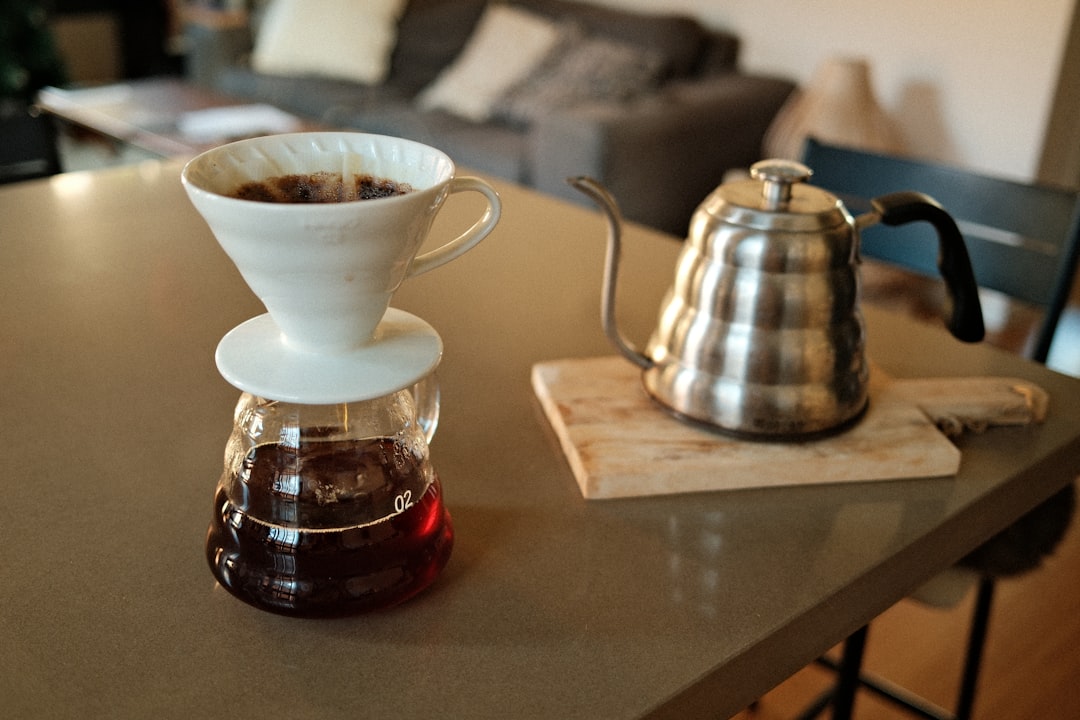
The fix isn’t complicated. Buy a second drink after the first ninety minutes. Tip like the seat is worth something, because it is. Or skip the outlet fight entirely and build the setup you actually need at home — a proper pour-over station and a bag that can carry you through a full morning of work, like Black Eye Breakfast Blend for the first push or Big Joe Blend if you’re planted at your own desk for the long haul. Save the café for what it’s actually built for: the twenty minutes where you’re present, cup in hand, nobody keeping time.
That’s the seat you’re not paying rent on. Don’t overstay it.